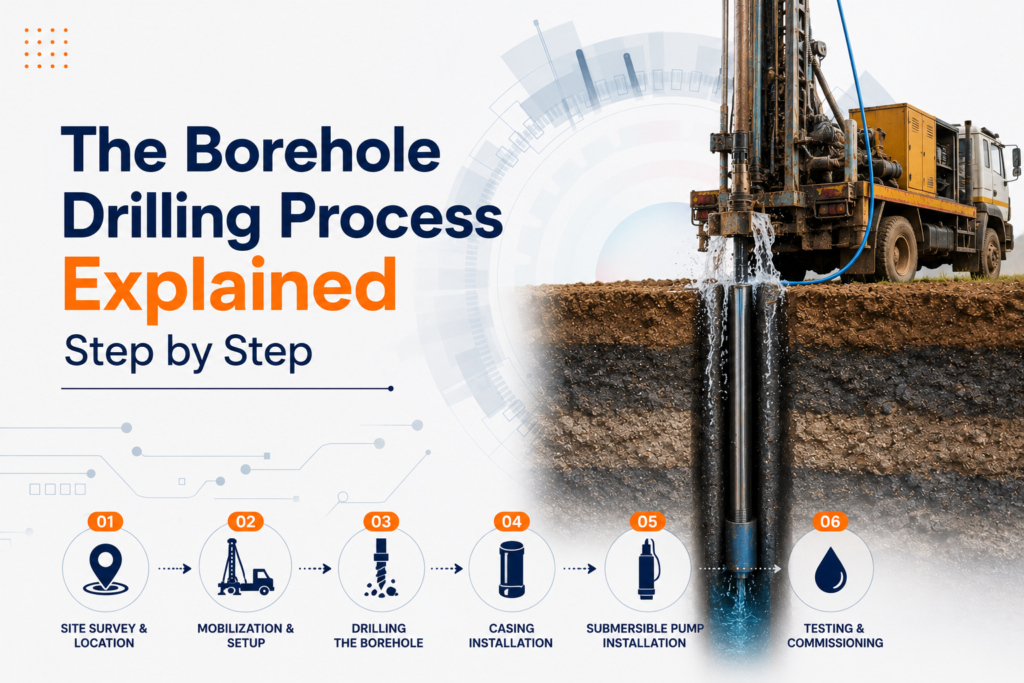
If you have never drilled a borehole before, the can feel like a mystery — you call a company, machines arrive, and water appears. Understanding the real steps helps you ask the right questions, tell a professional outfit from a careless one, and know exactly what you are paying for. Here is the in Ibadan, explained simply, from the first survey to the day clean water flows.
Step 1 of the borehole drilling process: Geophysical survey
Everything starts with a survey. A geophysical survey reads the underground rock and soil layers to find the spot on your property most likely to give a strong, lasting water yield, and to estimate how deep to drill. In Ibadan’s rocky terrain this step is not optional — it is the difference between a borehole that lasts for years and one that disappoints.
Step 2: Drilling
Once the best point is identified, the drilling rig is positioned and drilling begins. The driller bores down through soil and rock to the target depth set by the survey, going past the seasonal water table to reach a dependable aquifer. The time this takes depends on the depth and how hard the rock is. (If you are unsure how deep to drill, see our guide on how deep to drill in Ibadan.)
Step 3: Casing and screening
After the hole is drilled, it is lined with casing — strong piping that keeps the borehole walls from collapsing and stops surface contamination from getting into your water. Screens are placed at the water-bearing zones so clean water can flow in while sand and debris are kept out. Good casing is one of the most important parts of a durable borehole.
Step 4: Development and flushing
The new borehole is flushed and developed to clear out drilling debris and fine particles. This ensures the water runs clear and the borehole produces at its full capacity.
Step 5: Pump installation
Next, a pump is installed — usually a submersible pump for deeper boreholes, which sits down in the water and pushes it up to your storage tank with steady pressure. The right pump is matched to your borehole’s depth and your household or business water demand.
Step 6: Testing and handover
Finally, the borehole is tested to confirm its yield and water quality, connected to your storage and plumbing, and handed over to you. A professional driller will show you the system works and explain how to look after it.
Why every step of the borehole drilling process matters
Skipping or rushing any stage is how boreholes fail. At 3hrs.ng Drilling Services we carry out the full — survey, drilling, casing, development, pump installation, testing, and handover — for homes, estates, schools, and businesses across Ibadan and Oyo State.
Book a free site inspection to get started.
Leave a Reply